- Thread starter
- #201
Flag of Malaysia
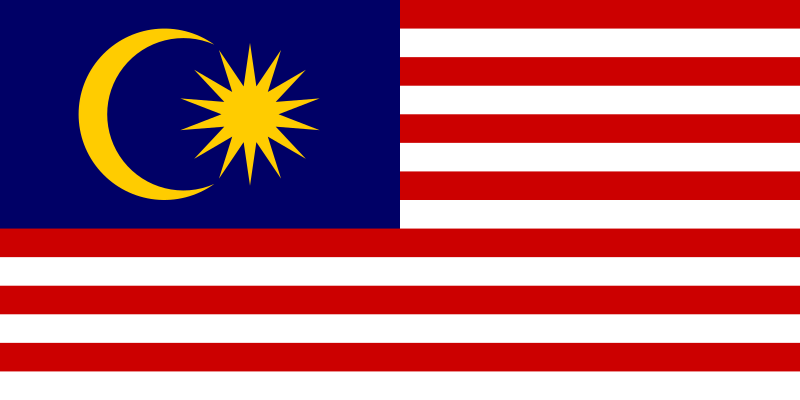
Ratio: 1:2 (normal)
Adopted: 26 May 1950 (as flag of the Malayan Federation, which would become independent on 31 August 1957). Current number of stripes and points in the star adopted on 16 September 1963 (Malaysia established).
Part 1
Rule 1: A child may not be able to draw the exact number of stripes or points in the star, but they can draw the rest of the flag from memory.
Rule 2: This may get complex. If you get confused, refer to this chart
In 1826 the British Strait Settlements were founded. They were Penang, Dinding (now known as Manjung), Malacca, and Singapore. Intitially, the Straits Settlements were under the rule of the British East India Company. (all of those territories, excluding Singapore, are now in Peninsular Malaysia).
In 1838 James Brooke, a British man, would come to Sarawak (a region of the island of Borneo), which was facing a rebellion against the Sultan of Brunei, which at that time ruled the area. Brooke would help to crush the rebellion, and to fight piracy, which in 1841 made the Sultan of Brunei grant him the title of Rajah of Sarawak and to cede Sarawak to him. Thus, after 1841 "White Rajahs" of the Brooke dynasty would rule the independent Kingdom of Sarawak.
In 1846 Labuan, a territory made up of the island of Lebuan and six other islands off the coast of Borneo, part of Brunei since the 15th century, was ceded to to the UK after the signing of the Treaty of Labuan. In 1848 Labuan would become a British Crown Colony.
In 1867 the rule of the British East India Company over the Straits Settlements would end, and the Strait Settlements would become a British Crown Colony. The British East India Company woul be dissolved in 1874.
In 1874 a British Residents System was established in Selangor. In the system, a British Resident General would hold the real power in Selangor, while the Sultan would remain as a figurehead. That year, the System would be established in Perak (a Sultanate) and Negeri Sembilan (a monarchy, whose monarch, the Yantuam Besar, is elected by a council of chiefs).
In 1882 Sabah, a region of Borneo, which was ruled by the Sultanate of Sulu, began to be ruled by the British North Borneo Company.
In 1885 Johor (a sultanate) would fall under the British Residents System.
In 1888 Sabah became the British Protectorate of North Borneo, Sarawak (which had annexed quite a lot of land from from Brunei, which was reduced to its current borders) became a British protectorate, and Pahang (yet another sultanate) fell to the British Residency System.
In 1890 Labuan would become part of the North Borneo Protectorate.
In 1895 Selangor, Perak, Negeri Sembilan, and Pahang would be united to form the Federated Malay States, ruled from 1896 to 1911 by Residents General, from 1911 to 1936 by Chief Secreataries to the Government, and from 1936 to 1946 by Federal Secretaries.
The Federated Malay States had a flag with four horizontal stripes, which from top to bottom were white, red, yellow, and black. On the center, the flag had a white circle with a Malayan tiger leaping to left on it.
Red and yellow were used in Selangor's flag, white, yellow, and black were used in Perak's, Black, red, and yellow were used in Negeri Sembilan's, and black and white were used in Pahang's.
In 1904 Labuan was separated from the Protectorate of North Borneo, and in 1906 it became part of the Strait Settlements.
In 1909 the Anglo-Siamese Treaty of 1909 was signed. It gave parts of southern Siam (Siam was the name of Thailand before 1939, and from 1945 to 1949) to the United Kingdom. The UK gained the protectorates of Kelantan (a sultanate), Terengganu (a sultanate), Kedah (a sultanate), and Perlis (not a sultanate, but a kingdom). The protectorates gained after the treat, along with Johor, were known as the Unfederated Malay States, because they were the parts of British Malaya that were not in the Federated Malay States or in the Strait Settlements.
In 1912 Labuan was separated from the Straits Settlements. This would be the last territorial change in what is now Malaysia... until 1941, when the Japanese Empire occupied Malaya and British Borneo. After the war ended, and Japan was defeated, Malaya and British Borneo would be under British military administrations. On 1 April 1946 the Federated Malay States, the Unfederated Malay States, and the Strait Settlements (except for Singapore, which would become a separate colony) were united to form the Malayan Union, a colony whose flag was the same as that of the Federated Malay States. On 1 July 1946 Sarawak became a crown colony, and on 15 July 1946 Labuan became part of North Borneo, which would become a crown colony.
The Malayan Union was unpopular with the Malays in the colony, due to it giving the Sultans less powers than they had before, and due to its easy granting of citizenships to immigrants. Malays would wear white bands around their heads, symbolizing the loss of their Sultan's political rights. Due to the unpopularity of the union, on 1 February 1948 the Federation of Malaya was founded. I t would be a confederation of nine states plus Penang and Malacca, which were colonies. The Federation of Malaya, at first, had the same flag as that of the Federated Malay States and of the Malayan Union. But in 1950 there was a competition for a new flag for the Federation of Malaya. Three flags were put forwards, and a flag with eleven aternating red and white stripes (with the topmost stripe being red) and a blue canton with a crescent and a five-pointed star (both yellow) on it, designed by Mohammed Hanzah, an 29-year old architect, was adopted, but with one alteration: the star was changed to have eleven points, since the five-pointed star was associated with communists, with which Malaya was fighting against at the time. In the flag, the blue symbolizes the unity of the Malaysian people, the crescent symbolizes Islam (Islam is Malaysia's state religion. 61.3% of Malaysians are Muslims), and the yellow symbolizes the royal colors of the Malaysian rulers. The eleven stripes symbolized the nine protectorates and two colonies of Malaysia, and the 11 points of the star the unity between them. The flag was based on that of the East India Company, which as you may remember ruled the Straits Settlements from 1826 to 1867.
The Federation of Malaya became indepedent on 31 August 1957, and what were once the protectorates and colonies in the Federation of Malaya became states (interestingly, after independence an elective monarchy was established).
On 22 July 1963 Sarawak became self-governing. On 31 August of that year, Singapore became independent and North Borneo would become self-governing. After the Malaysia Agreement came into effect on 16 September 1963, the Malayan Federation, Singapore, Sarawak, and North Borneo would unite to become Malaysia.
Malaysia's flag would be like the Federation of Malaya's, but with 14 stripes and a star with 14 points to represent the three new states in Malaysia.
Singapore and Malaysia did not have a good relation. After economic and political disagreements, and race riots, there was a vote in the Malaysian Parliament (in which no Singaporean delegates were present) on whether Singapore should be expelled from Malaysia. Expulsion was voted for 126 to 0. Even though Singapore was expelled, the number of stripes in the flag remained the same, making it so that the Malaysian flag had a meaningless stripe. However, in 1974 Kuala Lumpur, formerly part of Selangor, became a Federal Territory, and the number of stripes on Malaysian stripes made sense. Even though Labuan and Putrayaja have also become Federal territories, the 14th stripes doesn't symbolize a federal territory: it symbolizes the federal government.
Rule 3: Blue, yellow, red, and white. I like the colors of this flag.
Rule 4: The crescent and star is a simple emblem.
Rule 5: This flag is, interistingly, similar to that of the United States. The flags may be related: Malaysia's flag comes from the East India Company's, while the United States' first flag is either based on the East India Company's or on the Red Ensign.In any case, the emblems on the two flag's cantons are different enough for me to consider them distinctive.
Part 2
Federated Malay States (1895-1946) Malayan Union (1946-1948), Federation of Malaya (1948-1950)
 I'd like the flag if it didn't have the tiger.
Part 3
It's a good flag.
Ratio: 1:2 (normal)
Adopted: 26 May 1950 (as flag of the Malayan Federation, which would become independent on 31 August 1957). Current number of stripes and points in the star adopted on 16 September 1963 (Malaysia established).
Part 1
Rule 1: A child may not be able to draw the exact number of stripes or points in the star, but they can draw the rest of the flag from memory.
Rule 2: This may get complex. If you get confused, refer to this chart
In 1826 the British Strait Settlements were founded. They were Penang, Dinding (now known as Manjung), Malacca, and Singapore. Intitially, the Straits Settlements were under the rule of the British East India Company. (all of those territories, excluding Singapore, are now in Peninsular Malaysia).
In 1838 James Brooke, a British man, would come to Sarawak (a region of the island of Borneo), which was facing a rebellion against the Sultan of Brunei, which at that time ruled the area. Brooke would help to crush the rebellion, and to fight piracy, which in 1841 made the Sultan of Brunei grant him the title of Rajah of Sarawak and to cede Sarawak to him. Thus, after 1841 "White Rajahs" of the Brooke dynasty would rule the independent Kingdom of Sarawak.
In 1846 Labuan, a territory made up of the island of Lebuan and six other islands off the coast of Borneo, part of Brunei since the 15th century, was ceded to to the UK after the signing of the Treaty of Labuan. In 1848 Labuan would become a British Crown Colony.
In 1867 the rule of the British East India Company over the Straits Settlements would end, and the Strait Settlements would become a British Crown Colony. The British East India Company woul be dissolved in 1874.
In 1874 a British Residents System was established in Selangor. In the system, a British Resident General would hold the real power in Selangor, while the Sultan would remain as a figurehead. That year, the System would be established in Perak (a Sultanate) and Negeri Sembilan (a monarchy, whose monarch, the Yantuam Besar, is elected by a council of chiefs).
In 1882 Sabah, a region of Borneo, which was ruled by the Sultanate of Sulu, began to be ruled by the British North Borneo Company.
In 1885 Johor (a sultanate) would fall under the British Residents System.
In 1888 Sabah became the British Protectorate of North Borneo, Sarawak (which had annexed quite a lot of land from from Brunei, which was reduced to its current borders) became a British protectorate, and Pahang (yet another sultanate) fell to the British Residency System.
In 1890 Labuan would become part of the North Borneo Protectorate.
In 1895 Selangor, Perak, Negeri Sembilan, and Pahang would be united to form the Federated Malay States, ruled from 1896 to 1911 by Residents General, from 1911 to 1936 by Chief Secreataries to the Government, and from 1936 to 1946 by Federal Secretaries.
The Federated Malay States had a flag with four horizontal stripes, which from top to bottom were white, red, yellow, and black. On the center, the flag had a white circle with a Malayan tiger leaping to left on it.
Red and yellow were used in Selangor's flag, white, yellow, and black were used in Perak's, Black, red, and yellow were used in Negeri Sembilan's, and black and white were used in Pahang's.
In 1904 Labuan was separated from the Protectorate of North Borneo, and in 1906 it became part of the Strait Settlements.
In 1909 the Anglo-Siamese Treaty of 1909 was signed. It gave parts of southern Siam (Siam was the name of Thailand before 1939, and from 1945 to 1949) to the United Kingdom. The UK gained the protectorates of Kelantan (a sultanate), Terengganu (a sultanate), Kedah (a sultanate), and Perlis (not a sultanate, but a kingdom). The protectorates gained after the treat, along with Johor, were known as the Unfederated Malay States, because they were the parts of British Malaya that were not in the Federated Malay States or in the Strait Settlements.
In 1912 Labuan was separated from the Straits Settlements. This would be the last territorial change in what is now Malaysia... until 1941, when the Japanese Empire occupied Malaya and British Borneo. After the war ended, and Japan was defeated, Malaya and British Borneo would be under British military administrations. On 1 April 1946 the Federated Malay States, the Unfederated Malay States, and the Strait Settlements (except for Singapore, which would become a separate colony) were united to form the Malayan Union, a colony whose flag was the same as that of the Federated Malay States. On 1 July 1946 Sarawak became a crown colony, and on 15 July 1946 Labuan became part of North Borneo, which would become a crown colony.
The Malayan Union was unpopular with the Malays in the colony, due to it giving the Sultans less powers than they had before, and due to its easy granting of citizenships to immigrants. Malays would wear white bands around their heads, symbolizing the loss of their Sultan's political rights. Due to the unpopularity of the union, on 1 February 1948 the Federation of Malaya was founded. I t would be a confederation of nine states plus Penang and Malacca, which were colonies. The Federation of Malaya, at first, had the same flag as that of the Federated Malay States and of the Malayan Union. But in 1950 there was a competition for a new flag for the Federation of Malaya. Three flags were put forwards, and a flag with eleven aternating red and white stripes (with the topmost stripe being red) and a blue canton with a crescent and a five-pointed star (both yellow) on it, designed by Mohammed Hanzah, an 29-year old architect, was adopted, but with one alteration: the star was changed to have eleven points, since the five-pointed star was associated with communists, with which Malaya was fighting against at the time. In the flag, the blue symbolizes the unity of the Malaysian people, the crescent symbolizes Islam (Islam is Malaysia's state religion. 61.3% of Malaysians are Muslims), and the yellow symbolizes the royal colors of the Malaysian rulers. The eleven stripes symbolized the nine protectorates and two colonies of Malaysia, and the 11 points of the star the unity between them. The flag was based on that of the East India Company, which as you may remember ruled the Straits Settlements from 1826 to 1867.
The Federation of Malaya became indepedent on 31 August 1957, and what were once the protectorates and colonies in the Federation of Malaya became states (interestingly, after independence an elective monarchy was established).
On 22 July 1963 Sarawak became self-governing. On 31 August of that year, Singapore became independent and North Borneo would become self-governing. After the Malaysia Agreement came into effect on 16 September 1963, the Malayan Federation, Singapore, Sarawak, and North Borneo would unite to become Malaysia.
Malaysia's flag would be like the Federation of Malaya's, but with 14 stripes and a star with 14 points to represent the three new states in Malaysia.
Singapore and Malaysia did not have a good relation. After economic and political disagreements, and race riots, there was a vote in the Malaysian Parliament (in which no Singaporean delegates were present) on whether Singapore should be expelled from Malaysia. Expulsion was voted for 126 to 0. Even though Singapore was expelled, the number of stripes in the flag remained the same, making it so that the Malaysian flag had a meaningless stripe. However, in 1974 Kuala Lumpur, formerly part of Selangor, became a Federal Territory, and the number of stripes on Malaysian stripes made sense. Even though Labuan and Putrayaja have also become Federal territories, the 14th stripes doesn't symbolize a federal territory: it symbolizes the federal government.
Rule 3: Blue, yellow, red, and white. I like the colors of this flag.
Rule 4: The crescent and star is a simple emblem.
Rule 5: This flag is, interistingly, similar to that of the United States. The flags may be related: Malaysia's flag comes from the East India Company's, while the United States' first flag is either based on the East India Company's or on the Red Ensign.In any case, the emblems on the two flag's cantons are different enough for me to consider them distinctive.
Part 2
Federated Malay States (1895-1946) Malayan Union (1946-1948), Federation of Malaya (1948-1950)
Part 3
It's a good flag.