Badposter rates every country flag

I've been away from the cpmputer all day, so I'm posting this late.
.
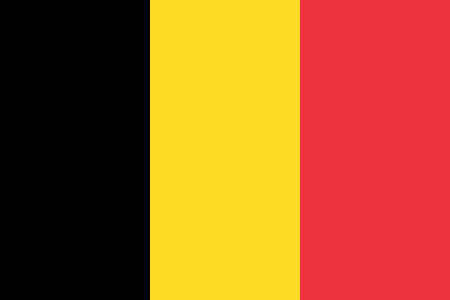
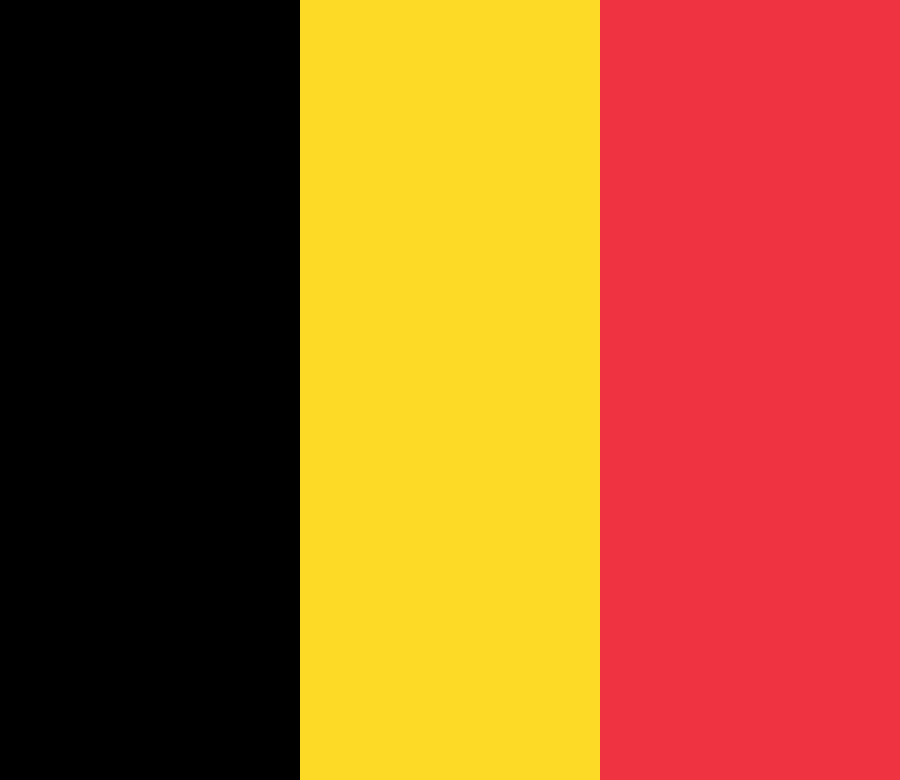
Flag of Belgium
450px-Flag_of_Belgium_%28civil%29.svg.png

Official flag (rarely used, has 13:15 proportions)
Flag_of_Belgium.svg
Part 1
Rule 1: The good thing about tricolors is that they can easily be drawn by a child from memory.
Rule 2: Sometimes, I copypaste, and sometimes I paraphrase. Today, I do the latter.
Wikipedia said:
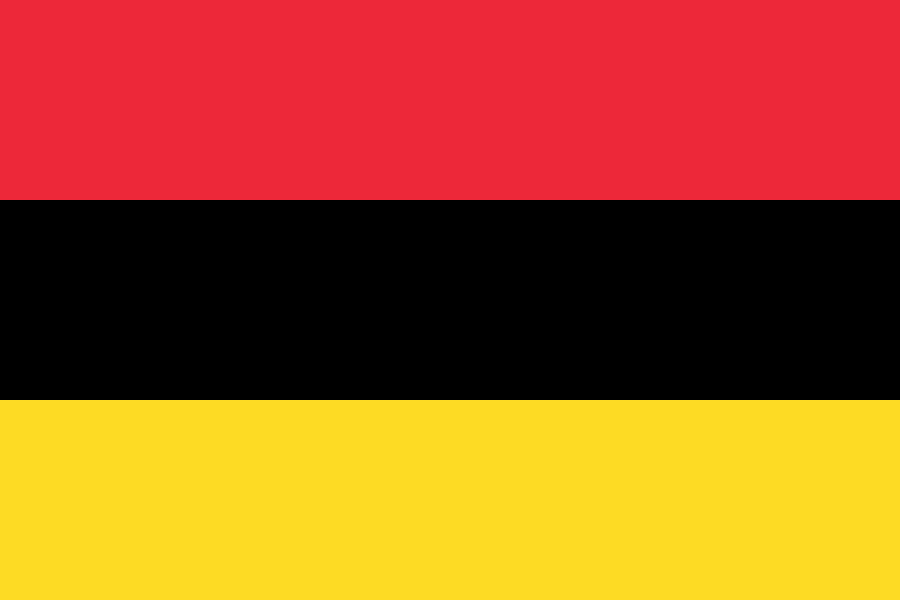
During the period of Austrian rule, a number of different flags were tried, until the Austrian Emperor imposed the Austrian flag. The population of Brussels was opposed to this, and following the example of France, red, yellow and black cockades began to appear; those being the colours of Brabant.[2] The colours thus correspond to the red lion of Hainaut, Limburg and Luxembourg, the yellow lion of Brabant, and the black lion of Flanders and Namur.[2]

On August 26, 1830, the day after the rioting at the Brussels Opera and the start of the Belgian Revolution, the flag of France flew from the city hall of Brussels. The insurgents hastily replaced it with a tricolour of red, yellow and black horizontal stripes (similar to the one used during the Brabant Revolution[2] of 1789-1790 which had established the United States of Belgium) made at a nearby fabric store. As a result, Article 193 of the Constitution of Belgium describes the colours of the Belgian nation as Red, Yellow and Black instead of using the order shown in the official flag.[3]

On January 23, 1831, the stripes changed from horizontal to vertical and October 12 saw the flag attain its modern form, with the black placed at the hoist side of the flag.[2] It is suggested[by whom?] that the change occurred to more clearly distinguish the flag of Belgium from the Dutch flag (which also has three horizontal stripes) - especially important during naval battles. Some[who?] see the change to vertical stripes as a gesture of sympathy with the French, again clearly separating the Belgians from the Dutch.[2]
So this flag has both history and symbolism. Just a side note about all the lions in the description; look at the Belgian coat arms (this has nothing to do with flags, it's just a fun tidbit)
Great_coat_of_arms_of_Belgium.svg
There are 24 lions in this coat of arms. Jesus. Or, should I say, Aslan?
And no, this flag has nothing to do with Germany's flag, which was adopted in 1919.
Rule 3: This flag uses black, yellow and red. Personally, I think this a great color combination.
Rule 4: This flags has neither text nor seals. It's a tricolor, but its color combination makes it not boring imo.
Rule 5: If you can't tell horizontal from vertical, or yellow from gold, or don't realize the two flags have different color orders, you could theoritically confuse the flaf with that of Germany. I doubt it, though.
Rule 2
Brabant Revolution (1789–1790)
Flag_of_the_Brabantine_Revolution.svg
This flag, like Germany's is and horizontal tricolors. However, this flag has a different color order than Germany's flag, and its yellow that (controversial opinion) looks better than Germany's gold.
1830–1831
Flag_of_Belgium_%281830%29.svg
Same as the above.
Rule 3
I love this flag. It's a tricolor, but it's not a boring one.
.
Next time, shirtless guys.

 
Charley Dietz said:
the heck are shirtless guys doing on a flag

strange world we live in
It's true.
Flag of Belize
Flag_of_Belize.svg

Part 1
Rule 1 Holy shit, look how complex this flag is. A child could not draw this flag from memory.
Rule 2: Look, there's no fucking way I'll write about all the symbolism on this flag. I'm copypasting.
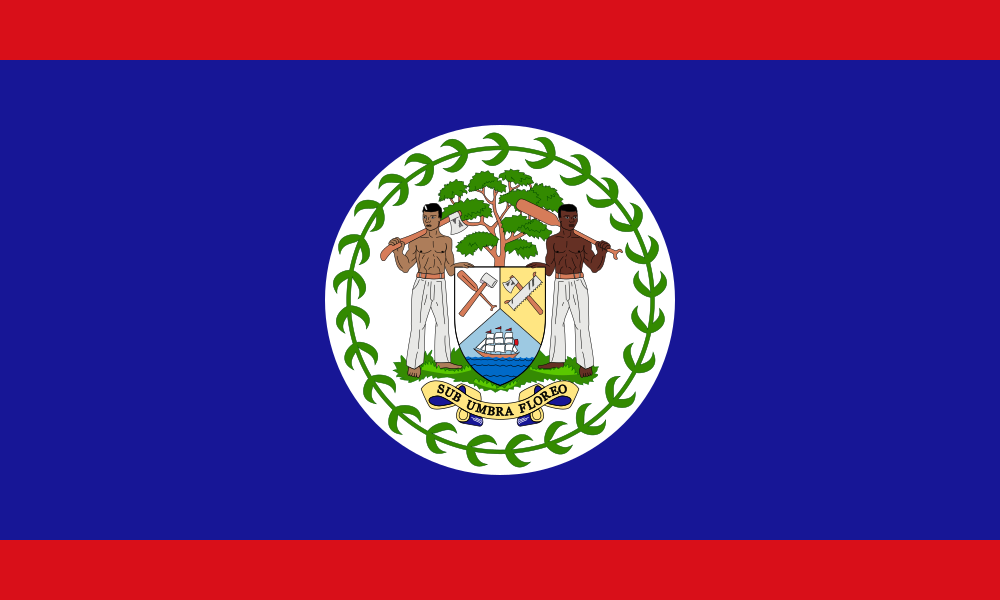
British Honduras obtained a coat of arms on January 28, 1907, which formed the basis of the badge used on British ensigns. The coat of arms recalls the logging industry that first led to British settlement there. The figures, tools, and mahogany tree represent this industry. The national motto, Sub Umbra Floreo, meaning “Under the Shade I Flourish”, is written in the lower part of the coat of arms.
The flag is royal blue, with a white disc at the centre containing the national coat of arms held by a mestizo and a black man. The flag of Belize is the only country to have humans depicted as a major design element on its national flag, although the flag of Malta contains an image of Saint George on the badge of the George Cross, and the flags of British dependencies Montserrat and the Virgin Islands, and that of French Polynesia also depict humans. [1] The flag is bordered at top and bottom by two red stripes.

The colours on the flag are respectively those of the country's national parties, the People's United Party (PUP) and United Democratic Party (Belize) (UDP). The UDP, established in 1973, had objected to the original blue and white design, those two colours being the PUP's representative colours.
The two red stripes at the top and bottom were added to the original design at independence. The coat of arms was granted in 1907. Red stripes were added to denote the colour of the opposition party. The 50 leaves recall 1950, the year PUP came to power.
I don't flags colors should symbolize political parties. Politics change, and flags should be timeless. Right now, those two parties are the dominant parties in Belize, but what happens if 100 years from now one of both of those parties are irrelevant?
Rule 3: According to Wikipedia, this flag has 12 colors. Too many colors!
Rule 4: The flag has text and a complicated emblem. Bad.
Rule 5: At least this flag is distinctive. Name any other flag with shirtless guys.
Part 2
British Honduras (1919-1981)
Flag_of_British_Honduras_%281919-1981%29.svg
It's a generic British colonial flag with two Union Jacks. And yet, I think it's better than the current flag. THAT's how bad I think this flag is.
Part 3
Unless you like shirtless guys, this flag is bad. However, some guy on Reddit has made various redesigns of the flag, which I think improve it.
.
Next time, our first flag with Pan-African colors.
 
Flag of Benin (:DDDD)
Flag_of_Benin.svg

Part 1
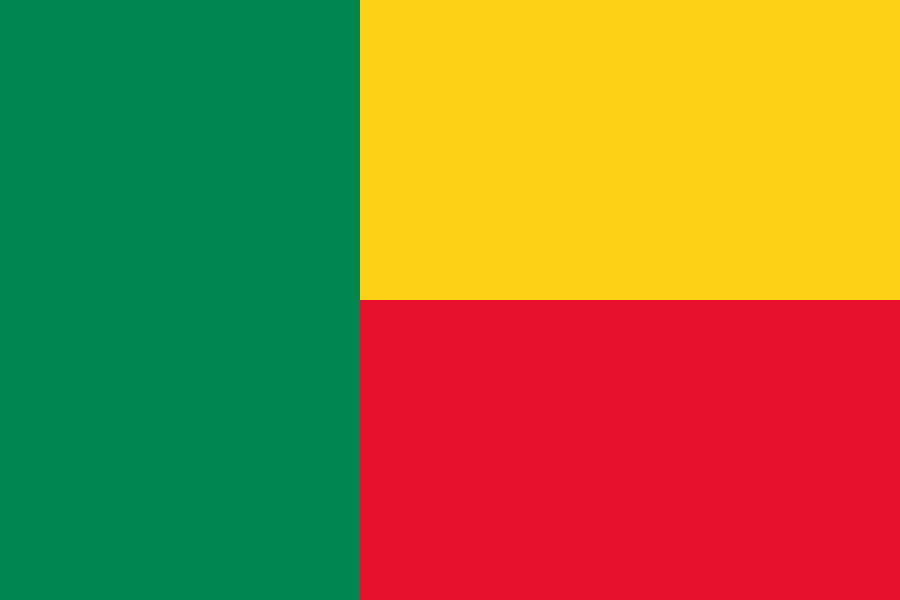
Rule 1: A child could draw this flag from memory. I don't have anything else to say about this.
Rule 2: This is our first flag with Pan-African colors. Many African countries use this colors because those are the colors of Ethiopia's flag. The reason the countries use the colors of Ethiopia's flag is because, except for a brief Italian occupation from 1936 to 1941, Ethiopia is the only African country that has never been conquered. Many countries with those colors also have them symbolize something specific to the country. In Benin's case, yellow represents the savannas in the country's north, green represents the palm trees in the country's south, and red represents what red represents.
Rule 3: Even if I think African countries use the Pan-African colors (green, red and yellow) too much, I don't think the colors look bad.
Rule 4: No text and no seals. It's a simple flag.
Rule 5: Honestly, the only flags with Pan-African colors I can distinguish are that of Ethiopia, Ghana (due to the World Cup), the Republic of the Congo, São Tomé and Principe, Burkina Faso and Zimbabwe. I think I'm gonna copypaste this in the future.
Rule 2
People's Republic of Benin (1975–1990)
220px-Flag_of_Benin_%281975-1990%29.svg.png
This flag was adopted by an authoritarian dictatorship, and it's too dominated by green, but at least it's distinctive.
.
Part 3
This flag, like most Pan-African ones, is boring in my opiniom.
 
Flag of Bhutan
Flag_of_Bhutan.svg

Part 1
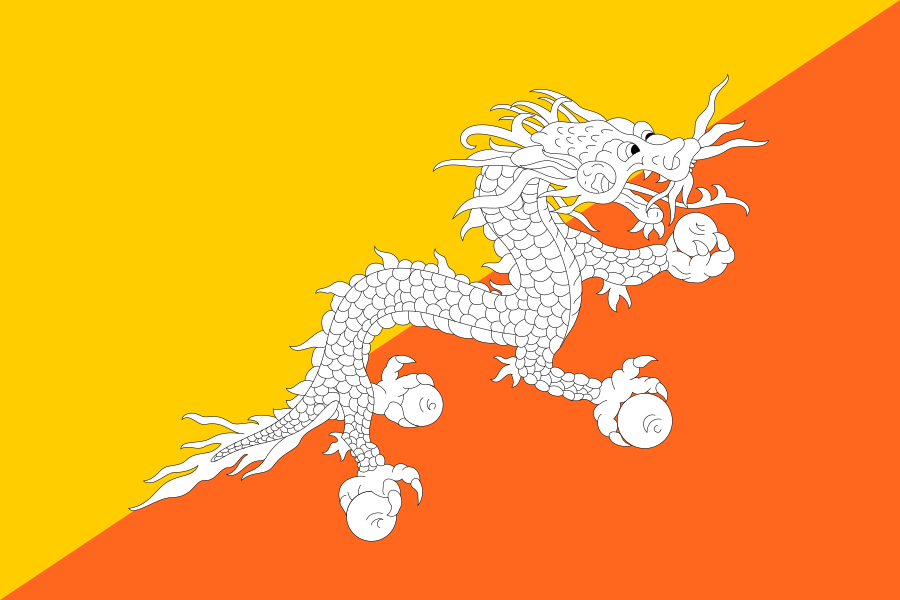
Rule 1: A child would draw this flag enthusiastically, but he couldn't draw this flag perfectly. Look at all the scales on the dragon!.
Rule 2: I actually know jackshit about Bhutanese culture, which this flag features. Thanfully, Wikipedia exists:
According to The Legal Provisions of the National Flag of the Kingdom of Palden Drukpa as Endorsed in Resolution 28 of the 36th Session of the National Assembly held on June 8, 1972, and as restated in the Constitution of 2008, the yellow signifies civil tradition and temporal authority as embodied in the Druk Gyalpo, the Dragon King of Bhutan, whose royal garb traditionally includes a yellow kabney (scarf).[10] The orange half signifies Buddhist spiritual tradition, particularly the Drukpa Kagyu and Nyingma schools.[10] Druk, the Thunder Dragon, spreads equally over the line between the colors. The placement of Druk in the center of the flag over the dividing line between the flag's two colors signifies the equal importance of both civic and monastic traditions in the Kingdom of Druk (Bhutan) and evokes the strength of the sacred bond between sovereign and people. The white color of Druk signifies the purity of inner thoughts and deeds that unite all the ethnically and linguistically diverse peoples of Bhutan.[8][10] The jewels held in Druk's claws represent Bhutan's wealth and the security and protection of its people,[11] while the dragon's snarling mouth symbolizes Bhutanese deities' commitment to the defense of Bhutan.[12]
I thought they just liked dragons
images

Rule 3: Yellow, orange and white. Orange is not a commonly used color in flag, which is a shame because it can look good, as this flag shows.
Rule 4: The dragon too complicated IMO,
Rule 5: This flag, the Qing dynasty's, and Wales' all have dragons, but all their dragons look different.
Part 2
Flag_of_Bhutan_%281949-1956%29.svg
I prefer the current dragon, but I like the green.
Part 3
This breaks some rules. This, however, doesn't matter, as all flags with a dragon are automatically good.
.
Next time, no beaches.