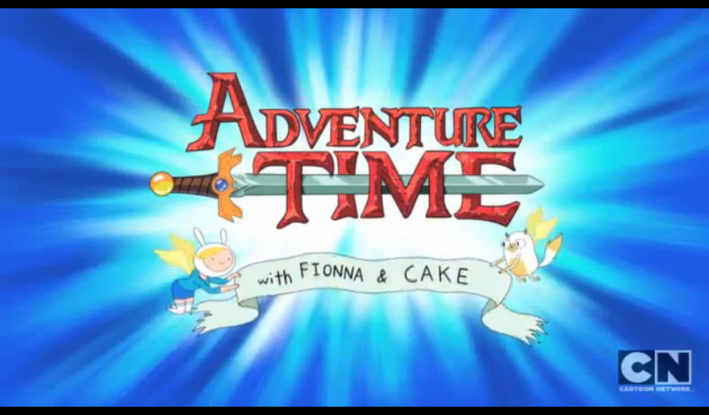
Here's an analysis by someone on another forum I go to on each one. Someone who likes both Adventure Time and Friendship is Magic.
[quote author=Altercation]
I am reminded of the age old argument of "apples vs oranges" in this thread and this question. It's fruitless to compare Adventure Time or Friendship is Magic because they're fundamentally different in tone, character and personality. I think the closest that you could conceivably get to a legitimate parallel is that both have this interesting whimsy to them that they capture, but when one production is thematically cynical and the other is idealist (and I shouldn't have to tell people which one is which) even that parallel falls apart at its' seams. They don't try to resemble each other and they both benefit greatly from it. The day that Adventure Time begins to resemble FiM or vice versa is the day that I stop watching. If you could take two absolutely random people - one avid Adventure Time fan and one avid FiM fan, and ask them to describe in general terms why they like their show so much, there's a good chance that these reasons will not be the same.
Thus, the question of which over which becomes as valid as the console wars.
With all that said, I'm going to default with this answer and I won't actually give one. I watch Adventure Time for different reasons than FiM (mostly, in any case), so I can't say which I prefer. I suppose that I'm more often inclined towards an episode of FiM (and arguably more digestible repeat viewings), but then I look forward to every week's installment of Adventure Time just as much as I look forward to an episode of FiM.
Actually, I suppose that's a bit of an exaggeration. I do like FiM and Adventure Time both for one particular reason: the characters. While I prefer how the interplay between characters drives story in FiM over the event driven Adventure Time's method, I think both teams have succeeded in developing endearing, funny, interesting characters, and both casts are what I would call "wins" in terms of female characters in western animation.
As an aside, I'm not sure where the "continuity" complaints are specifically coming from. Especially when you consider that a Hasbro mandate for FiM was that almost every episode could be viewed out of order. Thus why people can, say, recommend Dragonshy to first time viewers rather than the pilot. I'd actually argue that Adventure Time is about as consistent in terms of continuity as FiM is. Again, there's no serialization in FiM that makes going through random order difficult. But the series occasionally past events and follows a broad story arc (in S1's case, the Gala) that the season slowly marches towards. Characters develop, albeit subtly and some only barely. There are some backgrounds or visuals that correlate to previous episodes, and callbacks such as pets or even some changes in relationship dynamics (Applejack and Rarity or Pinkie Pie and Rainbow Dash).
Adventure Time is... largely the same. There are no real "arcs", but there's a consistent forward direction to the story that the show takes in event placement and character development. Continuity is sometimes hard to notice, but it's clearly there. Someone already addressed the Lich King (a season two villain referenced in season one), so the biggest example that occurs to me is Princess Bubblegum's transformation into a thirteen year old girl. That doesn't resolve itself in the episode where it comes up, but in fact, something like three episodes later. And the method that they use to turn her back is only understandable if you actually watched the episode where she was de-aged. In that sense, I could argue that Adventure Time is in fact stronger in terms of consistent continuity. Most of it is rather subtle, though. For example, an artifact that Finn and Jake acquire in one episode is used in a later episode, Finn loses a sword and gains another, and character development actually follows a linear path.
I'd go so far as to say that the character development for pretty much all the characters in the show is what completely anchors the continuity. I'll use Marceline (the vampire rocker girl) as an example, because her development (and her relationship with the others) is probably the easiest to see and understand. She arrives one episode to throw Finn and Jake out of their house because she used to own it, and acts as that episode's antagonist. Finn becomes aggressive when she shows up the very next time, where she pranks him into making him believe he's not doing the right thing. Over the course of more episodes featuring her, their relationship shifts around, lines are drawn and some are smudged, to the point where they're pretty much unambiguously friends. Jake is an even more extreme example of this. Because unlike Finn, he's still scared of Marceline for a good while, but slowly begins to warm up to her and lower his defenses. The difference in his attitude towards Marceline would make no sense if you went from say, Henchman to Marceline's Closet.
If it isn't clear already, I consider myself something of a fan of Adventure Time.
tl;dr the comparison is pointless, FiM and Adventure Time is a perfect example of "different strokes for different folks", they're both great shows in their own right, and I talk way too much about the fact that continuity in Adventure Time is as big as an issue as it is in FiM.
[/quote]