Badposter rates every country flag

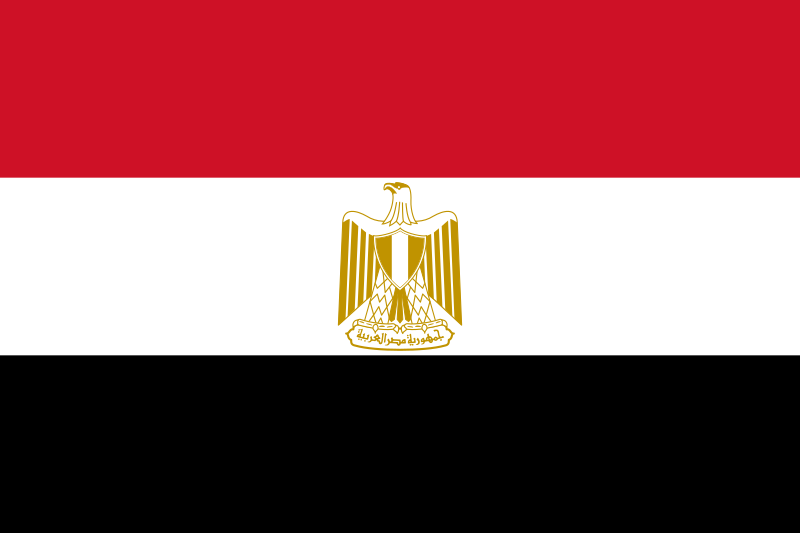
Flag of Egypt
800px-Flag_of_Egypt.svg.png

Ratio: 2:3 (not interesting)
Adopted: 4 October, 1984.
Part 1
Rule 1: I think the eagle is a little too complex.
Rule 2: We've already seen Pan-African and Pan-Slavic colors, so it's time for me to write about Pan-Arab colors.
Basically, there are two set of Pan-Arab colors: the most used set uses red, black, green and white. These colors were first used in the 1916 Arab Revolt against the Ottoman Empire and each color represented an Arab dynasty: black represented the Abbasids, white the Ummayads, green the Fatimids and red the Hashemites.
The other set uses red, white and black and is derived from the Arab Liberation Flag, which was used in the 1952 Egyptian Revolution which overthrew the country's monarchy. The red represents the period before the monarchy and the British occupation of Egypt, the white symbolizes the fact that the Revolution was bloodless and the black represents the end of oppresion of Egypt by both the monarchy and foreign imperialism.
The golden eagle at the middle also originated with the Revolution (though the most current version is from 1984) and is known as the Eagle of Saladin.
Rule 3: Red, white, black and yellow. I honestly don't like the Pan-Arab colors that much, but I do like the yellow. I like this flag's colors.
Rule 4: The text on the flag says "Arab Republic of Egypt". I don't think you should put a country's name on a flag. Flags should be distinctive enough to make naming the country unneccesary. Also, the eagle is complex imo.
Rule 5: But if the eagle were removed this flag would be identical to Yemen's. Honestly, I think Pan-Arabs look too much like each other, though I think the yellow eagle makes this flag distinctive.
Part 2
Khedivate of Egypt (1867-1881)
Flag_of_Muhammad_Ali.svg
Looks too much like Turkey's imo.
Khedivate of Egypt (1881-1914) and Sultanate of Egypt (1914-1922)
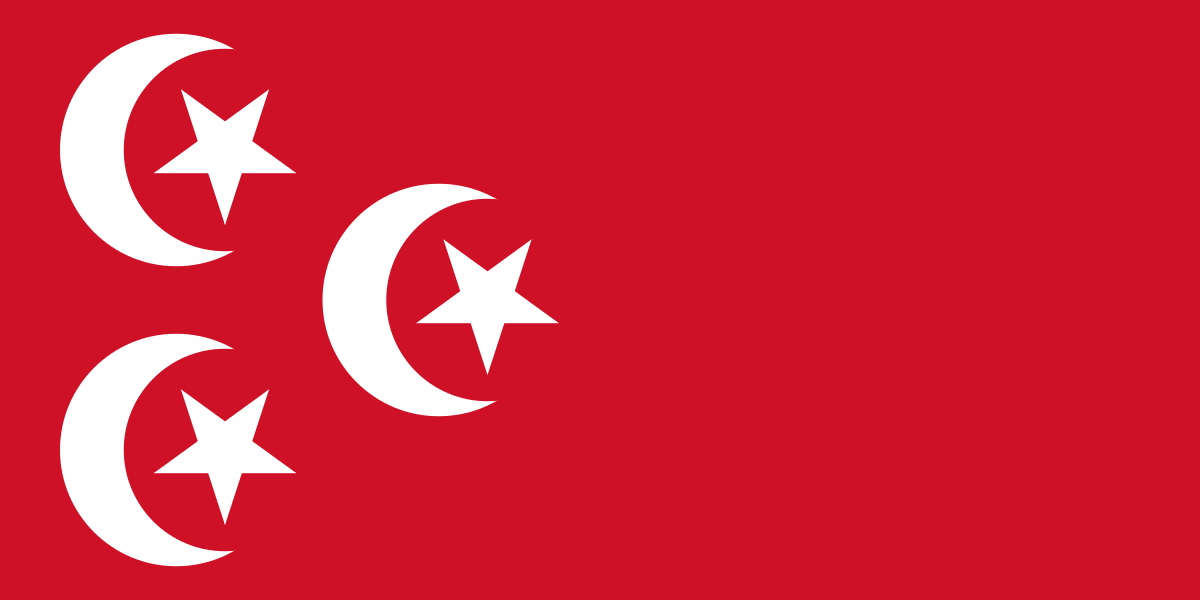
Flag_of_Egypt_%281882-1922%29.svg
Three crescents and three stars. Pretty interesting, and not that bad.
Kingdom of Egypt (1922-1953)
Flag_of_Egypt_%281922%E2%80%931958%29.svg
Not a bad flag, but Egypt is no longer a kingdom, and besides
Wikipedia said:
The three stars symbolised the three component territories of the Kingdom, namely Egypt, Nubia, and Sudan,[4] whilst the green signifies the agricultural nature of the country
Sudan is no longer part of Egypt, and Nubia is partially in Sudan.
Republic of Egypt (1953–1958)
Flag_of_Egypt_%281952-1958%29.svg
That's a pretty big eagle (also, what is it holding?)
United Arab Republic (1958-1972) (The United Arab Republic was a federation formed by Egypt and Syria formed in 1958. Even though Syria left the federation after a coup d'état in 1961, Egypt kept the name until 1971)
Flag_of_United_Arab_Republic.svg
This flag is identical to Syria's flag, which I will write about in the future.
1972-1984 (In 1971, a referendum to unite Egypt, Syria and Libya in a federation passed (though it was probably fraudulent, since the country in which the referendum was closest was Syria, in which federation got 96.4%. Federation “got” 99.9% in Egypt. If you're rigging a vote, at least make it plausible!). Due to disagreements over the merger, the federation never got off the ground, and ended in 1977)
Flag_of_Egypt_%281972-1984%29.svg
I prefer the current eagle. It has a better shade of yellow.
Part 3
Honestly, I like this flag, even if the eagle is complex. The yellow makes it different from other Pan-Arabs
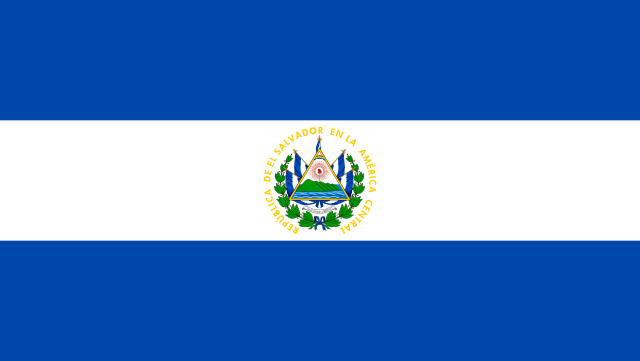
 
Flag of El Salvador
State ensign
640px-Flag_of_El_Salvador.svg.png

Ratio: 189:335 (pretty odd ratio)
Adopted: 27 May 1912
Civil ensign (note: has a 3:5 ratio)
Civil_Flag_of_El_Salvador.svg
Part 1
Rule 1: A child could not draw the state ensign (I'm pretty sure you know why) , but they could draw the civil ensign.
Rule 2: This flag uses the symbolism of most Central American countries , which I have already explained:
Me writing about Costa Rica's flag said:
First, some history. From 1823 to 1838, Costa Rica was part of the Federal Republic of Central America along with Guatemala, Honduras, Nicaragua, El Salvador and Los Altos (which was annexed quickly by Guatemala and Mexico). The Federal Republic's flag was influenced by Argentina's flag and had two blue stripes (representing the Pacific and Atlantic Oceans), and a white stripe between them (representing the land between them). The blue and white of this flag, and of every country that was a member of the Federal Republic's flag, comes from this
And for the coat of arms, I'm not copypasting it because Wikipedia has a pretty long description of it. Instead, I'm linking it. The Salvadorean coat of arms has a lot of details.
Rule 3: Blue and white and a lot of other colors in the coat of arms. Blue and white is a rather nice color combination, and I like the shade of blue on the flag. But the coat of arms make the state ensign have too many colors.
Rule 4: The civil ensign is rather simple. The state ensign, on the other hand, is rather complex, and has two instances of text. The first is in yellow and around the coat of arms and says REPUBLICA DE EL SALVADOR EN LA AMERICA CENTRAL (Republic of El Salvador in Central America). I repeat, flags should be distinctive enough so that it's unneccesary to put the country's name on them. The second instance is above the wreath and is pretty dang tiny, and has the words DIOS UNION LIBERTAD (God Union Liberty). That text was so tiny I didn't even realize it existed until I read about it on Wikipedia. Not good.
Rule 5: This flag is actually more distinctive without the coat of arms. There is no emblemless blue and white horizontal (or vertical) triband. On the other hand, the state ensign could be confused with Nicaragua's flag.
Part 2:
(Note: I don't count the flags from the period El Salvador was part of the Federal Republic of Central America, which lasted until 1841)
1841-1842, 1844-1865
Civil_Flag_of_El_Salvador.png
This flag has a civil ensign
1842-1844
Flag_of_the_United_Provinces_of_Central_America.svg
I actually think this flag is worse than the current flag, because i think it has a worse shade of blue and that its coat of arms is just as bad.
1865-1912 (El Salvador actually had 5 different flags during this period, the only difference being the number of stars in the canton. A new star was added with the creation of a new province (like the United States does with its states). The first flag of this style (May-June, 1865) had nine flags, and the last (which is the one I'm showing and was used from 1877 to 1912) had 14)
Flag_of_El_Salvador_%281875-1877%29.svg
I like this flag. It's simple and related (it was influenced by that of the US) but distinctive (the numbers of stars and stripes and ways the colors are arranged are the different)
Part 3
The state ensign is terrible, but the civil ensign is okay.
 
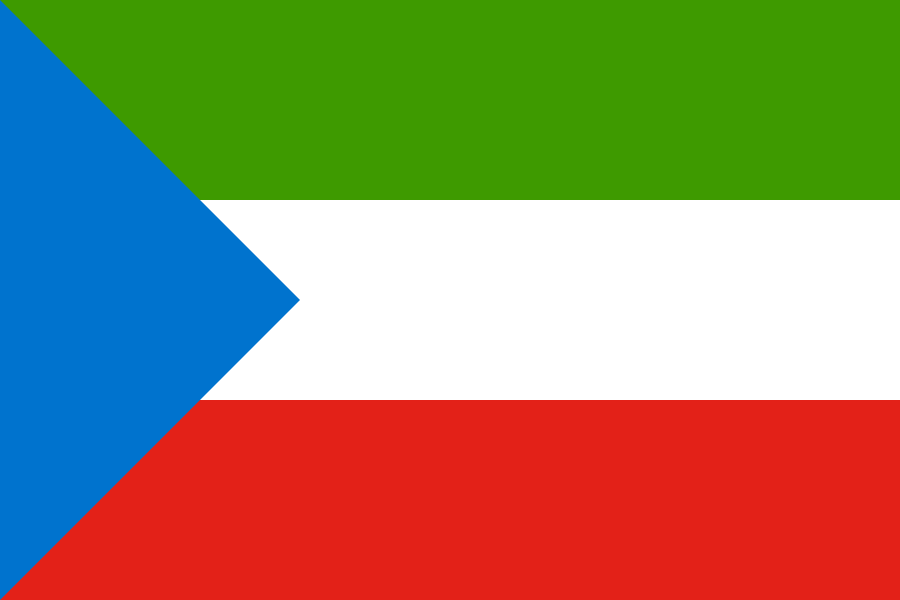
Flag of Equatorial Guinea
800px-Flag_of_Equatorial_Guinea.svg.png

Ratio: 2:3 (not interesting)
Adopted: 21 August, 1979
Part 1
Rule 1: Well... I think a child could (assuming they knew the Latin script), though I'm not 100% sure. But I don't think the coat of arms is too complex.
Rule 2: Green represents the country's jungles and agriculture. Blue represents the sea (fuck me), which connects the country's islands and its mainland (the country's capital, Malabo, is actually on the island of Bioko, though most Equatorial Guineans live on the mainland), white represents peace (the country hasn't really had war, but it has been ruled by two brutal dictators: Francisco Macías Nguema (who killed two thirds of the country's original legislature, had one third of the Equatorila Guinean population flee the country and changed the national motto to "There is no other God than Macías Nguema", and his nephew, Teodoro Obiang Nguema (who executed Francisco Macías), who, while not quite as bad as his an uncle is still a bloody dictator who has a cult of personality, uses the country's oil wealth to enrich himself and whose security forces are guilty of murder, kidnapping and torture. Fuck them both). Red represents the blood shed during the country's independence (though its independence wasn't that bloody. But Equatorial Guinean history is still bloody)
I'm gonna do what I commonly do with the symbolism of coat of arms: copypaste it from Wikipedia.
The arms consists of a silver shield with a silk-cotton tree, which was derived from the arms of Rio Muni. Above the shield is an arc of 6 six-pointed yellow stars, that represent Rio Muni and the offshore islands. Beneath the shield is a silver scroll with the national motto, Unidad, Paz, Justicia ("Unity, Peace, Justice").
Rule 3: Red, white, green and blue (I don't count the colors in coats of arms) . Even though I don't like the blue wedge, it al least makes the flag distinctive compared to Hungary's or North Rhine-Westphalia's
Rule 4: This flag has text which translates to "Unity, Peace, Justice" (the text is in Spanish. Equatorial Guine is the only country in Africa where the main language is Spanish, which is spoken by 67.6% of the country's population). Also, while the country's coat of arms isn't complex, the tree is pretty ugly.
Rule 5: Even without the coat of arms, the flag is pretty distinctive, since the blue wedge makes this flag different from other green white and red tricolors.
Part 2
1968-1973
Flag_of_Equatorial_Guinea_%28without_coat_of_arms%29.svg
Better than the current.
1973-1979
Flag_of_Equatorial_Guinea_1973-1979.svg
That chicken looks bad, and so does the coat of arms.
Part 3
Looks much better without the coat of arms.
 
The index is growing long, so I spoiler tagged it.
Flag of Eritrea
800px-Flag_of_Eritrea.svg.png

Ratio: 1:2 (not an unusual ratio)
Adopted: 23 May, 1993 (Ertitrean independence) (ratio changed from 2:3 to 1:2 in 1995)
Part 1
Rule 1: A child could draw the flag from memory, though they wouldn't draw the wreath perfectly. But if you've read my writeups you already know my opinion on recognizability and perfection. (and if you haven't I'll tell you I think the former is more important)
Rule 2: The green represents the country's agriculture and livestock, the blue represents the sea (Eritrean independence landlocked Ethiopia) and red represents the blood shed during Eritrean independence (Eritrea became independent from Ethiopia in a bloody war. Eritrea is one of the few current countries to become independent from another African country, along with Namibia (which became independent from South Africa), South Sudan (which became independent from Sudan) and partially Sudan (ruled by both Egypt and the UK)
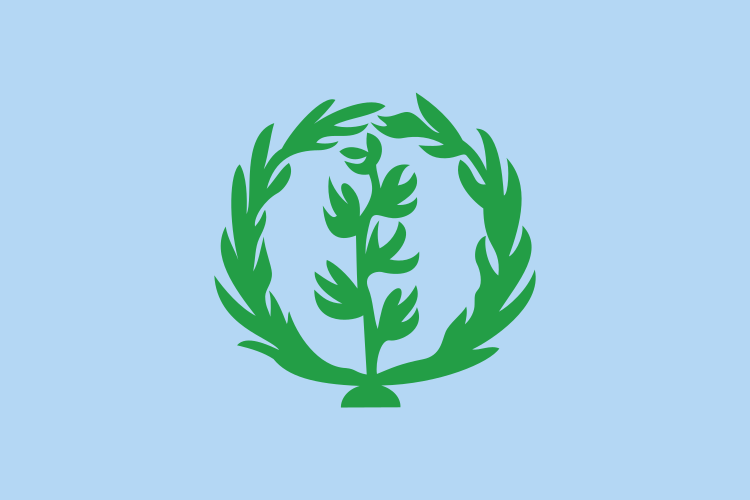
The wreath come Eritrea's 1952-1962 flag (from when it was in a federation with Ethiopia). Then, it represented peace. In the 1952-1962 flag, and from 1993 to 1995 the wreath had 28 leaves. In 1995 this was changed to 30 for the number of years Eritrea's independence war lasted (the war began in 1961 and ended in 1991)
This flag is pretty similar to that of the Eritrean People's Liberation Front, which led Eritrean independence (and whose succesor, the Eritrean People's Liberation Front, is the only legal political party in Eritrea. Eritrea is dead last in Reporter Without Borders' Press Freedom Index, ranking even worse than North Korea). The only differences between Eritrea's flag and the ELPF's is that the ELPF's flag has a star instead of a wreath and a 2:3 ratio.
Rule 3: Green, red, blue and yellow. This flag doesn't have amazing colors, but they're not bad either.
Rule 4: I think the wreath is too complex, but that's just my opinion-
Rule 5: This flag is diatinctive even without the wreath.
Part 2
1952-1962 (when Eritrea was part of the Ethiopian-Eritrean Federation)
Flag_of_Eritrea_%281952-1961%29.svg
The light blue comes from the UN's flag (Eritrea was federeated with Ethiopia with an UN Resolution). I actually don't really like that shade of blue.
1993-1995 (2:3 ratio, 28 leaves)
Flag_of_Eritrea_%281993-1995%29.svg
I actually prefer this to the current flag. The triangle looks less stretched.
Part 3
I don't like the wreath, but other than that the flag's okay.
 
Flag of Estonia
640px-Flag_of_Estonia.svg.png

Ratio: 7:11 (somewhat unusual, but it's no 189:335)
Adopted: 21 November 1918 (re-adopted 7 August 1990, a year before its independence from the Soviet Union.
Part 1
Rule 1: Emblemless tricolors are simple.
Rule 2: The blue represents freedom and truth... and also the sea and sky (I wonder how many flags have this symbolism), black represents soil and lost independence, and the white represents the promise and pursuit of a brighter future.
This flag also looks like an Estonian forest.
Rule 3: Blue, black and white. Pretty good colors.
Rule 4: This flag has neither text nor emblems. Not much to say when this happens.
Rule 5: This flag is pretty distinctive. The only national flag with the same colors is Botswana's flag (also a great flag), which isn't a triband.
Rule 2:
Estonian SSR (1953-1990)
Flag_of_the_Estonian_Soviet_Socialist_Republic.svg
The Soviet occupation of Estonia was bad, and this flag is worse than the current.
Part 3
This is a very good flag. It's one of my favorites.
 
Flag of Ethiopia
800px-Flag_of_Ethiopia.svg.png

Aspect Ratio: 1:2 (normal)
Adopted: The colors have been around since. The current emblem was adopted on 31 October, 1996.
Part 1
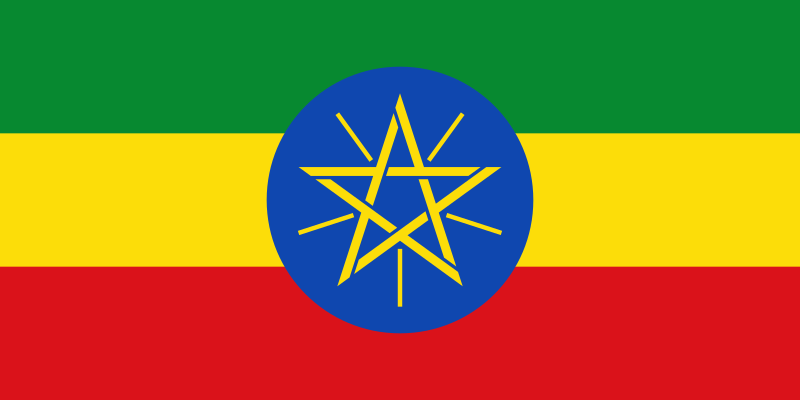
Rule 1: Well, I'm pretty bad at drawing, but I could draw the star. I think a child could draw this from memory.
Rule 2: Green represents Ethiopia's land, yellow represents peace (Ethiopia has been in some wars, but right now it's at peace) and red symbolizes strength.
As for the emblem, blue represents peace (this is redundant, since yellow also represents peace. But at least it doesn't represent the sky (it can't represent the sea, since Ethiopia is landlocked)), the star represents diversity (Ethiopia's pretty diverse. Its most spoken language, Omoro, is only spoken by one third of the population) and unity, and the rays symbolize prosperity.
Ethiopia, along with Liberia, was the only country to not be colonized in the Scramble for Africa (though it was annexed by Italy from 1936 to 1941), so many African countries were inspired by this flag's colors when designing their flag. Thus all Pan-African flags come from Ethiopia's.
Part 3: Red, yellow, green nd blue. Ethiopia was the first country to use the Pan-African colors, which aren't really bad. I just think they're overused, though I can't blame Ethiopia for this since it's the first country to use them.
Part 4: The flag has an emblem, but it's a simple one.
Part 5: The Pan-African copypasta:
Me said:
Honestly, the only flags with Pan-African colors I can distinguish are that of Ethiopia, Ghana (due to the World Cup), the Republic of the Congo, São Tomé and Principe, Burkina Faso and Zimbabwe. I think I'm gonna copypaste this in the future.
Part 2
Ethiopian Empire (1897-1974)